
Key Takeaways
- Employees lose an average of 4 to 6+ hours per week switching between disconnected tools — a hidden productivity drain most entrepreneurs underestimate.
- Fragmented tech stacks lead to significant inefficiencies, increased operational costs, and reduced business impact compared to streamlined alternatives.
- Platform consolidation is not just about saving money — it is about building a business you own, with data and audience access no third party can revoke.
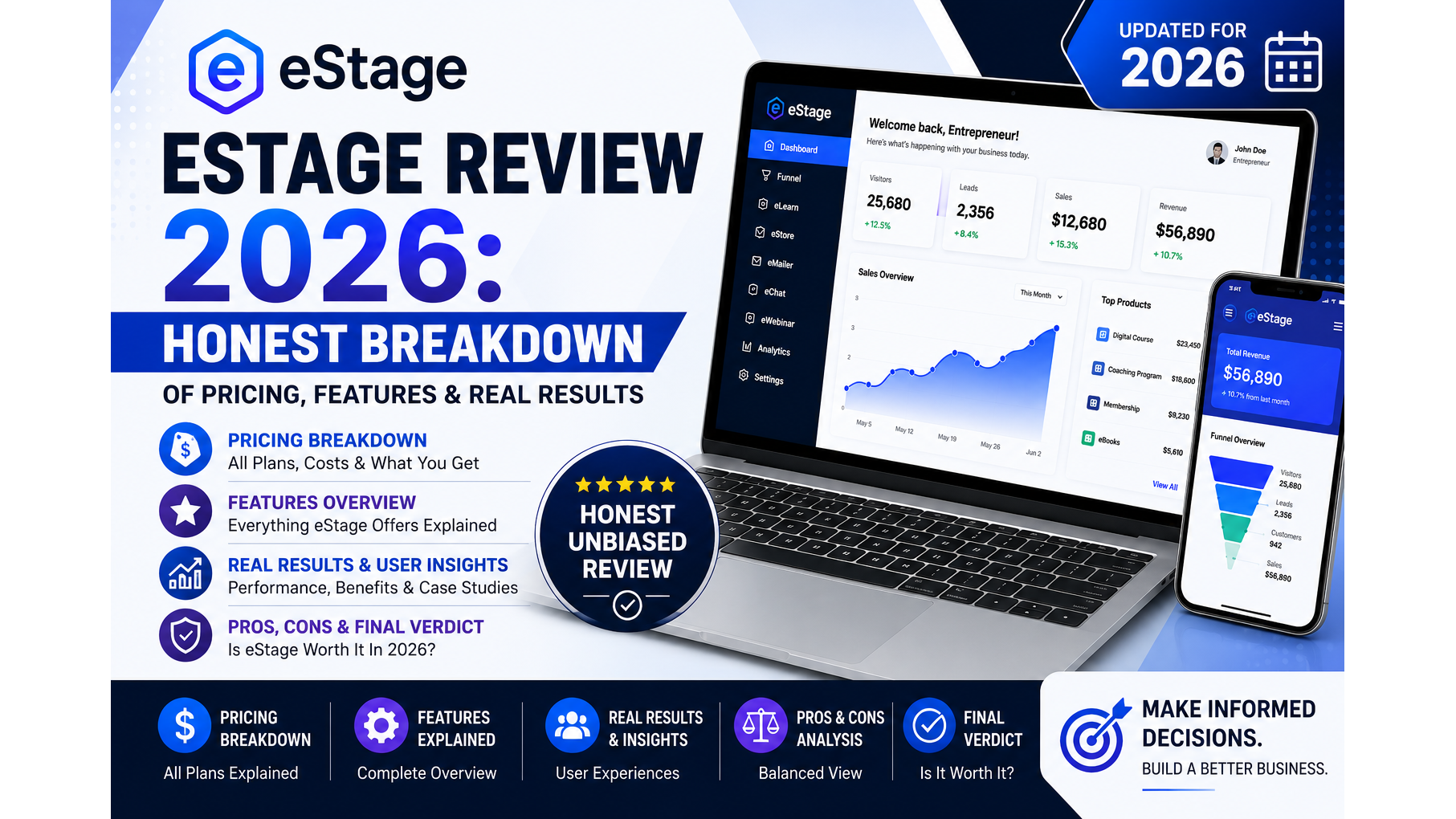
- Estage is one of the leading consolidated platforms designed specifically for digital entrepreneurs, combining websites, funnels, CRM, community, and monetization under one roof.
- The biggest strategic risk most creators overlook is not competition — it is audience ownership, and it is covered in depth further below.
Running an online business in 2026 should not feel like juggling a dozen spinning plates. Yet for most digital entrepreneurs and creators, that is exactly what it feels like — logging into one tool to build funnels, another to manage email, a third for community, and a fourth just to check who bought what. The fragmented tool stack era had its moment, but the cracks are showing. This review breaks down why platform consolidation is becoming the baseline competitive strategy — and how solutions like Estage are designed to make that shift practical.
The Average Entrepreneur Wastes Hours Every Week Just Switching Between Tools
Productivity research confirms what most online business owners already feel: employees and operators can lose anywhere from 1 to 1.5 hours every single day just moving between different software tools. Multiply that across a five-day work week, and it adds up to 4 to 6+ hours gone — not to strategy, content creation, or sales, but to the sheer mechanical friction of a disconnected system.
That is not a minor inconvenience. That is nearly an entire workday lost every week to digital housekeeping. For a solo creator or small team already stretched thin, those hours represent lost revenue, delayed launches, and creative energy burned on logistics instead of growth. The real sting is that most of these tool-switching costs are invisible — they do not show up on any invoice, but they absolutely show up in results.
What makes this problem especially stubborn is that each individual tool often seems justified. A best-in-class email platform here, a specialized community tool there, a funnel builder for conversions. The logic is sound in isolation. But the moment those tools need to communicate with each other — or the moment a creator needs a single clear view of their business — the seams start to show. For a closer look at how consolidated platforms are addressing this specific challenge, estageexplained.com offers a thorough breakdown of the hub-centric model in practice.
Fragmented Stacks Are Quietly Killing Your Business
SaaS Sprawl: Small Businesses Now Manage Dozens of Separate Tools
The term SaaS sprawl sounds like corporate jargon, but the numbers behind it are striking. Even a relatively small company with 1 to 199 employees now manages an average of 42 to 44 separate SaaS subscriptions — and for digital-first businesses, that number climbs fast. Larger organizations have reported managing well over 100 individual tools across their operations.
Every new subscription added to the stack introduces a new login, a new billing cycle, a new support relationship, and a new surface area for things to break. The compounding effect is what hurts most. What starts as a sensible, modular approach to building a tech stack gradually becomes an operational maze that drains time, attention, and budget — often without anyone noticing how bad it has gotten until a key integration breaks or a renewal bill arrives.
Fragmented Data Means You Are Always Flying Blind
Data silos are one of the least glamorous topics in online business — and one of the most damaging. When customer data lives in five different systems that do not talk to each other, no single dashboard tells the full story. A creator might know how many email subscribers opened a campaign, and separately know how many people joined their community that week, but have no reliable way to connect those two events into actionable insight.
Business impact analysis on fragmented systems consistently shows that data silos severely limit innovation and increase operational costs through the need for separate licenses and support teams, and lead to partial, incomplete decision-making at the leadership level. In practical terms: decisions get made on gut feeling or lagging indicators instead of real-time, unified data. That is a strategic disadvantage that compounds over time.
Swivel-Chair Integrations and the Hidden Cost of Manual Work
There is a term used in enterprise operations that applies just as well to solo digital businesses: swivel-chair integrations. It describes what happens when two systems do not natively communicate — a human has to manually copy data from one to the other, physically swiveling between screens to keep records in sync. It sounds almost quaint, but the consequences are significant.
Operational inefficiency reports consistently flag swivel-chair integrations as a primary source of human error, delayed reporting, and obscured real-time visibility into business performance. For an online entrepreneur running a course business or coaching practice, this might look like manually exporting email subscribers into a CRM, then separately updating a spreadsheet with purchase data, then cross-referencing community membership lists. Each step is an opportunity for data to fall through the cracks — or for hours to disappear into administrative work that should be automated.
What the Hub-Centric Model Actually Changes
One Dashboard: Websites, Funnels, CRM, Community, and Monetization
The hub-centric model flips the fragmented approach entirely. Instead of stitching tools together and hoping the integrations hold, everything operates from a single unified system. Websites, conversion funnels, customer relationship management, private communities, and monetization tools all share the same data layer — which means every action a visitor takes, from clicking a landing page to joining a membership, is tracked and visible in one place.
The practical impact of this is hard to overstate. When a coach can see that a specific lead visited three funnel pages, joined the community, engaged in two discussions, and then purchased a course — all in a single view — that is not just convenience. That is the kind of business intelligence that used to require an entire analytics team. A consolidated hub makes it the default experience rather than a luxury.
It also changes how businesses scale. Adding a new offer, a new course, or a new membership tier in a hub-centric system does not mean purchasing and onboarding another tool. It means using existing infrastructure in a new configuration. That is a fundamental shift in how digital businesses grow — less overhead per new revenue stream, not more.
Why Rented Land Is a Business Risk, Not Just a Buzzword
The phrase do not build on rented land gets repeated often enough in creator circles that it can start to feel like a cliché. But the underlying risk is very real. When a community lives on Facebook Groups, a course library lives on Teachable, and an email list lives in Mailchimp, the business is functionally dependent on the continued goodwill — and stable terms of service — of three different corporations.
Any one of those platforms can change its algorithm, increase its pricing, restrict access, or in extreme cases, suspend an account entirely. The creator’s audience does not migrate automatically. Years of relationship-building, content, and community investment can be disrupted overnight by a policy change the creator had no input on. A consolidated hub hosted on a creator’s own domain changes that dynamic entirely — the platform risk collapses to a single, controllable point rather than being distributed across multiple third parties.
The Real Cost Comparison: Consolidated vs. Fragmented
All-in-One Platforms Can Deliver Significant Cost Savings
The financial case for consolidation is well-documented. Businesses that migrate to all-in-one platforms have reported meaningful cost reductions compared to purchasing individual tools for website hosting, CRM, chatbots, social media management, and email marketing separately. Studies indicate software spend reductions in the range of 20 to 30% for many businesses, with some reporting substantially higher savings depending on the complexity of the stack being replaced.
Brands implementing unified commerce strategies have also reported a 22% lower Total Cost of Ownership and 20% faster implementation compared to multi-vendor stacks that require continuous integration maintenance. These are not marginal improvements — they represent a structural shift in how profitably a digital business can operate.
Fragmented Stacks Drive Up Costs and Reduce Business Impact Across the Board
The flip side of consolidation savings is the hidden tax that fragmented stacks impose. Research on fragmented tech environments consistently shows that businesses operating with disconnected tool stacks spend significantly more on technology while achieving measurably less business impact than their more streamlined competitors. That is a double loss: paying more and getting less.
The cost is not only in subscriptions. It includes the developer or VA hours spent maintaining integrations, the customer data lost when systems fall out of sync, the delayed launches that happen when a new tool needs to be vetted and onboarded, and the strategic attention diverted from growth toward maintenance. When all of those costs are accounted for, the cheaper fragmented stack is rarely cheaper at all.
Audience Ownership: The Strategic Advantage Most Creators Overlook
You Do Not Legally Own Your Social Media Audience
This is the part most creators do not want to sit with too long. Legally, creators do not own their audiences on major social platforms. The platform controls access, distribution, and — most critically — account status. The followers, subscribers, or group members a creator has built over years are, from a legal standpoint, users of the platform who happen to follow that creator. If the platform suspends the account, restricts reach, or shuts down entirely, the creator has no legal recourse to recover that audience.
This is not a niche legal technicality. It is a structural reality that has played out publicly and repeatedly — accounts suspended without warning, organic reach throttled in favor of paid promotion, entire platform features deprecated after creators built workflows around them. The audience is real. The ownership is not.
Direct Channels Survive Algorithm Changes; Followers Do Not
Permission-based communication channels — primarily email lists and private hosted communities — operate on a fundamentally different model. When someone joins an email list or a private community on a creator’s own domain, the creator controls the communication channel. There is no algorithm deciding whether that message gets delivered. There is no feed competing for attention. There is no platform policy that can revoke access to the relationship.
Creator economy analysis consistently shows that audience ownership cultivated through direct channels is resilient to platform volatility in a way that follower counts simply are not. A creator with a small but highly engaged email list often generates more reliable revenue and deeper relationships than one with a large social following — because the communication is direct, owned, and not subject to algorithmic filtering. Consolidating those direct channels into a hub that the creator controls is the logical extension of that principle.
What Estage Delivers as a Consolidated Platform
1. High-Performance Website and Funnel Builder
Estage starts at the foundation: a website and funnel builder that operates as a single, integrated system rather than two separate tools bolted together. The practical difference is significant. Visitors move from an awareness-stage web page into a conversion funnel without crossing platform boundaries, which means no data gaps at the handoff point and no broken experience if one integration misfires. The builder is designed for speed and conversion — not just aesthetics — making it functional for both brand presence and active lead generation within the same environment.
2. Built-In CRM With Full Interaction Tracking
The CRM in a consolidated platform like Estage is not a separate tool synced via Zapier — it is native. Every interaction a contact has across the entire hub is tracked automatically: page visits, funnel completions, community posts, course progress, purchase history. That unified contact record enables meaningful segmentation, personalized follow-up, and accurate reporting without any manual data stitching. For coaches and course creators especially, this kind of complete contact visibility changes how effectively they can serve and convert their audience.
3. Private Community Hosting on Your Own Domain
One of the most strategically important capabilities in any consolidated hub is hosting a private community on a creator’s own domain — not on Facebook, not on Circle, not on a subdomain owned by a third party. Estage enables this directly. Members join a community that lives inside the creator’s branded ecosystem, which reinforces authority, eliminates social media distractions, and — most critically — means the creator retains full control over membership data and access regardless of what happens on any external platform.
4. Memberships, Courses, and Live Streaming in One Place
Content delivery and community engagement are often handled by two or three separate platforms in a fragmented stack: a course platform, a community tool, and a live streaming service that may or may not integrate cleanly with either. Estage consolidates all three into the same environment. Courses, membership areas, and live workshops all exist within the same hub, accessible through the same login, and tracked through the same CRM. For creators scaling content-based offers, this removes the technical overhead that typically grows with each new product launched.
5. Unified Monetization Dashboard
Revenue management across a fragmented stack typically means reconciling data from multiple payment processors, platform-native checkout tools, and membership systems — each with its own reporting format. A unified monetization dashboard within Estage consolidates memberships, recurring subscriptions, and one-time offers into a single revenue view. The operational benefit is cleaner financials and faster decision-making; the strategic benefit is that every revenue stream feeds back into the same audience data, enabling smarter offer sequencing and customer lifetime value tracking.
Who Gets the Most Value From This Approach
Content Creators and Community Builders Escaping Platform Risk
For creators who have built their audience primarily on social platforms, the appeal of consolidation is mostly about risk reduction. Years of content, community relationships, and brand equity are currently sitting on infrastructure owned by someone else. A consolidated hub does not replace social media as a discovery channel — it replaces social media as the destination. Creators can continue using Instagram, YouTube, or TikTok to reach new audiences while driving those audiences into an owned ecosystem where the relationship is protected from algorithm changes and platform policy shifts.
Community builders face a similar calculus. A thriving Facebook Group or Discord server represents real social capital, but it is entirely dependent on those platforms remaining stable, accessible, and aligned with the community’s needs. Moving community infrastructure to an owned hub is a one-time migration that eliminates an ongoing and unpredictable risk.
Coaches, Course Creators, and Agencies Scaling Without the Overhead
For coaches and course creators, the consolidation value proposition is less about risk and more about operational efficiency. Every new offer in a fragmented stack typically means evaluating a new tool, setting up a new integration, and adding another line item to the monthly budget. In a consolidated hub, new offers — whether a group coaching program, a self-paced course, or a live intensive — are deployed within existing infrastructure. The marginal cost of scaling is lower, and the data quality is higher because everything stays within the same system.
Agencies serving digital entrepreneurs benefit from the model differently. A consolidated platform gives agency clients better data, faster onboarding, and more sustainable infrastructure — which translates to stronger client retention and cleaner delivery. Instead of managing a client’s ClickFunnels account, their Circle community, their Kajabi courses, and their Mailchimp list as four separate engagements, an agency can deliver and manage a single hub that handles all of it. That is a fundamentally more scalable service model.
Consolidation Is Not Optional Anymore — It Is the Competitive Baseline
The digital business environment in 2026 has crossed a threshold. Platform consolidation used to be a smart optimization for operators who were already doing well. Now it is closer to table stakes. The efficiency gap between consolidated businesses and fragmented ones is wide enough — and well-documented enough — that staying fragmented is an active competitive disadvantage, not a neutral choice.
The significant technology cost premium that fragmented businesses pay, the 4 to 6+ weekly hours lost to tool-switching, the audience ownership risk inherent in social-platform dependence — these are not abstract concerns. They compound quietly, and they compound fast. The businesses gaining ground in the creator economy and online education space are increasingly the ones that treated their tech infrastructure as a strategic asset rather than an afterthought.
Consolidation also changes the exit story. A business with unified data, an owned audience, documented community relationships, and all revenue streams under one roof is a fundamentally more valuable and transferable asset than a patchwork of subscriptions and integrations held together by custom Zapier workflows. Whether the goal is to scale, to sell, or simply to operate without constant friction, the hub-centric model delivers structural advantages that compound over time — not just in cost savings, but in clarity, control, and long-term brand equity.
For entrepreneurs ready to move past the fragmented stack and build something they actually own, Saaswired covers the tools, strategies, and platforms helping digital business owners build smarter, more consolidated operations.
Saaswired
1201 W Peachtree St NW
Atlanta
Georgia
30309
United States


