From Operators to Orchestrators: Deloitte’s 2026 Global Technology Leadership Study Reveals a New Mandate for Tech Leaders
PR Newswire
NEW YORK, April 30, 2026
A new era of technology leadership is here, but most enterprises are not yet equipped to keep pace
NEW YORK, April 30, 2026 /PRNewswire/ —
Key takeaways | Explore Key Insights
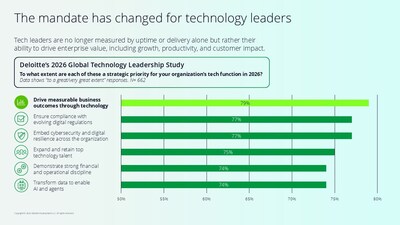
- The mandate has fundamentally shifted: The majority of tech leaders (79%) cite driving business outcomes as their top priority, signaling a definitive move from running systems to creating enterprise value.
- There’s a new standard for tech leadership: As AI raises the stakes, success will likely require more than technical expertise. Tech leaders today should also be ready to lead people through change, build AI-ready teams, and turn technology ambition into business results.
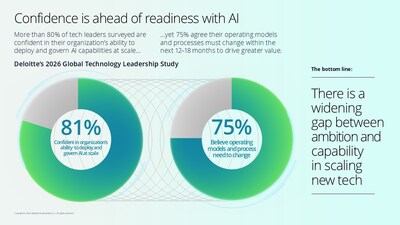
- Ambitions are outpacing capabilities: While 81% of leaders are confident they can scale AI, 75% simultaneously state their operating model must fundamentally change to drive greater value.
- Leadership is now about orchestration over authority: As influence becomes distributed across an expanding tech C-suite—71% of organizations have five or more tech leaders —the role has evolved from control to coordination.
Why this matters
The role of the technology leader is undergoing a profound transformation. Today’s tech leaders are not only expected to run technology, but to shape strategy, lead change, build AI-ready teams, and drive enterprise-wide outcomes, according to Deloitte’s 2026 Global Technology Leadership Study. The research, which surveyed more than 660 senior technology executives, finds that while the mandate has changed, the enterprise has not. And leaders are caught between the bold ambition of an AI-driven world and the structural reality of legacy operating models, talent, and budget, creating a critical test of leadership.
The AI-era is challenging boards and leaders to rethink how they operate, compete, and create value, and the technology is no longer the only challenge, but there is structural lag within the enterprise. The gap between a tech leader’s expanded mandate and their organization’s ability to execute is where competitive advantage can be won or lost. The organizations that empower their leaders to close this gap — by redesigning how work gets done, how decisions are made, and how value is created — can define the next decade.
As AI raises the stakes, success will likely depend less on technical oversight alone and more on the ability to bring people, priorities, and decisions together across the enterprise. That means leading human-AI collaboration, building trust and talent, and translating technology ambition into action. In the orchestration era, leaders can stand out by combining technical depth with the judgment and influence to drive meaningful business outcomes.
Key quotes
“The era of the operational technologist is over. This shift has been building for over a decade, and AI is the catalyst bringing that into focus. Today’s CIO isn’t just leading technology; they are being asked to redesign the very fabric of how the business runs. As operating models and investments catch up to this new reality, success will be defined by judgment and trade-offs. This is the moment for tech leaders to redefine their mandate and their organization’s trajectory.”
- Anjali Shaikh, Managing Director, Deloitte Consulting LLP, Leader of Deloitte Global CIO & US Tech Executive Programs
“For years, we’ve tracked the tech leader’s journey toward the center of the business. This year’s study shows they have arrived, but the enterprise wasn’t fully prepared for them. The challenge is significant, but the opportunity is immense. Today’s leaders are defined by their ability to orchestrate across the C-suite and translate technology into measurable outcomes. Those who remain focused solely on delivering underlying systems risk being sidelined, while those who embrace this moment can lead their organizations into the future.”
- Steve Pratt, Principal, Deloitte Consulting LLP, US Tech Exec Programs Leader
The research revealed three shifts redefining technology leadership:
1. The Value Mandate: From Uptime to Outcomes
Technology’s role has evolved from enabling the business to shaping its strategy. Leaders are now expected to deliver measurable enterprise value across growth, productivity, and customer impact. The data shows this is not an emerging trend, but the new standard, as 79% of leaders report it is their top priority. However, 42% report low or no ROI on AI investments, demonstrating the difficulty of delivering on this new value mandate.
2. The Capability Gap: Ambition vs. Reality
A stark paradox has emerged between leaders’ confidence and their organizational reality. As expectations rise, many organizations are still catching up on the foundational data, talent, and operating models needed to translate AI investments into sustained outcomes. Challenges to scaling AI are not the technology itself, but internal constraints like poor data quality, security concerns, talent shortages, and legacy systems, creating a gap between ambition and execution.
3. The Resource Squeeze: More Mandate, Same Model
Balancing competing priorities is intensifying as tech leaders are now expected to run, change, protect, and grow the business simultaneously. However, they are operating within funding models and governance structures that have not kept pace. With tech spending projected to rise only modestly and 41% of tech leaders reporting the business sees them as unable to keep up with demand, leaders are being forced to make difficult trade-offs that can stifle transformational innovation.
The 2026 Global Technology Leadership Study unpacks the evolving priorities, ambitions, and challenges of the tech C-suite.
Learn more about our Tech Executive Programs and connect with us on LinkedIn.
Methodology
Deloitte conducted an online survey among more than 660 technology leaders across the globe from December 2025 to February 2026. Participants were screened based on title, company size, company revenue, and responsibility for setting the strategic direction of technology within their organization.
About Deloitte
Deloitte provides industry-leading audit, consulting, tax and advisory services to many of the world’s most admired brands, including nearly 90% of the Fortune 500® and more than 9,000 U.S.-based private companies. At Deloitte, we strive to live our purpose of making an impact that matters for our people, clients, and communities. We bring together distinct talents, technologies, disciplines, and an ecosystem of alliances to help tackle today’s most complex business challenges and drive long-term progress. Deloitte is proud to be part of the largest global professional services network serving our clients in the markets that are most important to them. Bringing more than 180 years of service, our network of member firms spans more than 150 countries and territories. Learn how Deloitte’s approximately 470,000 people worldwide connect for impact at www.deloitte.com.

 View original content to download multimedia:https://www.prnewswire.com/news-releases/from-operators-to-orchestrators-deloittes-2026-global-technology-leadership-study-reveals-a-new-mandate-for-tech-leaders-302758075.html
SOURCE Deloitte LLP